
Harris County Most Wanted Fugitives
Sheriff's investigators keep a short list of fugitives they most want the public's help finding. The Harris County Sheriff’s Office Most Wanted page is that list. It is not a warrant index. It is not a jail roster either. Law enforcement picks certain names for extra attention and asks anyone with information to come forward, while plenty of people with active warrants never show up there at all. Expect the lineup to shift. Names come off when someone is captured or cleared, and new ones take their place. There is no fixed count and no posted schedule, so think of the page as a live notice board rather than a growing archive.
A photograph sometimes appears with a listing. HCSO releases those images for a public-safety reason, and that choice does not extend to ordinary booking photos elsewhere in the county's system. The sheriff's own HCSO Most Wanted list is the only place to see what HCSO has chosen to publish.
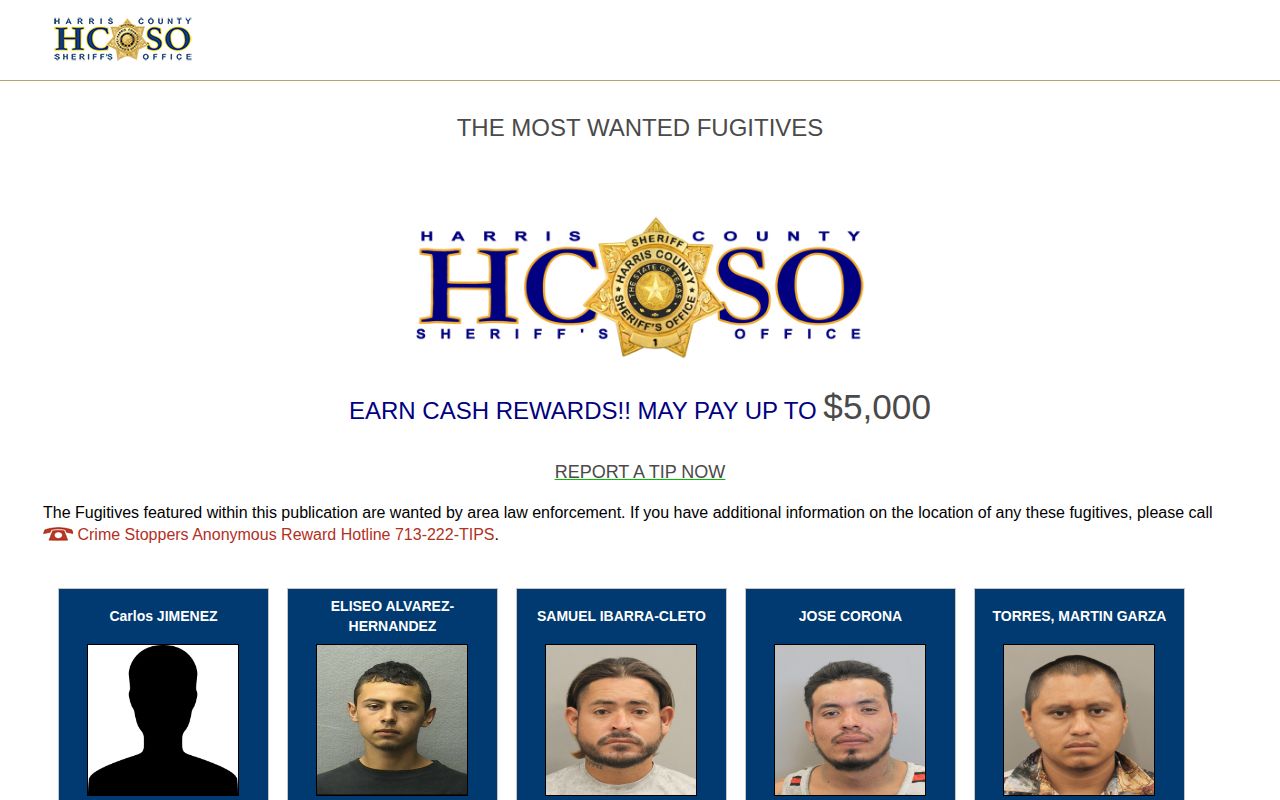
A capture like this shows why the page works as a notice with specific fields. It is not a complete Harris County warrant or booking database.
What a Harris County Wanted Notice Shows
The most wanted format identifies who is sought. It also says why the agency wants help. Fields vary from entry to entry. Some show no photo, just the label "No Picture Available." Read the labels as the agency's own description of a current notice.
| Field | What it communicates |
|---|---|
| Name | The identity HCSO associates with the notice. |
| Photo status | An agency-published image where available, or a “No Picture Available” notice. |
| Physical descriptors | Descriptive details intended to help the public distinguish the listed person. |
| Warrant number | The identifying number shown by the agency for the wanted matter. |
| Serious-charge description | The charge or charge description HCSO places on the notice, not a disposition. |
How to Use the Harris County Most Wanted List
Use the list for two things. Read the Sheriff's Office public notices. Send information through the published reporting route. That is where its usefulness ends. Do not try to track someone down, match a face to a name, or make contact. Keeping the line between a public notice and an official record clear keeps everyone safer.
- Open the current HCSO Most Wanted page and read the notice, warrant number, and agency wording.
- Compare only the information HCSO actually publishes. Do not assume a name match identifies a person.
- If you have information, use the published Crime Stoppers channel instead of approaching or publicly tracking anyone.
- After an agency reports a capture, use the county’s official custody and booking lookup guide to distinguish a current booking from a prior or incomplete notice.
Harris County Tips and Crime Stoppers
HCSO sends public tips tied to its most wanted notices to Crime Stoppers of Houston. The route is described as anonymous. A reward may be advertised. Whether a tip qualifies, whether any reward gets paid, and how information is handled are all decided by Crime Stoppers and the participating agencies. A reward offer never authorizes a private citizen to intervene.
Crime Stoppers of Houston
Anonymous tip line: 713-222-TIPS
Rewards of up to $5,000 may be available. That figure comes from HCSO's Most Wanted page. Send information about a listed person through the published tip channel. Never approach the person yourself.
Check a Harris County Warrant Safely
A most wanted notice answers one narrow question: whom has HCSO chosen to feature. A warrant check asks something different. It looks for whether an official court or warrant channel holds a record for a specific person. The HCSO Warrant Search covers Class A and Class B misdemeanor warrants plus other processes issued by a Harris County Criminal Court at Law. HCSO says it updates daily and requires secondary official verification. Officers must not use it to confirm warrants or apprehend anyone. So a result is a lead to verify, never a final answer. Match your search to the court type involved. If a real person or an active case is at stake, work through the court, a licensed attorney, or the responsible public office. Skip the self-help route. Do not rely on a website result as legal advice.
- Start with the HCSO warrant search for the Class A, Class B, and Criminal Court at Law scope it describes.
- For felony or other county criminal case research, check the Harris County District Clerk’s public search and its Criminal Party Inquiry or docket path.
- Verify a possible county warrant with the Harris County Criminal Warrants Division at 713-755-6055.
- For Houston municipal matters, contact Houston Municipal Courts at 713-837-0311 or call 311.
- Ask the appropriate court or a licensed attorney what lawful next step applies to the person and case.
Harris County Warrant Types and Records
Different portals answer different questions. HCSO's warrant search is not a universal court system. A custody result does not prove a warrant exists. Match the search to the court type. That single habit keeps an incomplete result from turning into a wrong conclusion about someone's record.
| Record route | Scope described in the research | Important limit |
|---|---|---|
| HCSO Warrant Search | Class A and B misdemeanor warrants and other Harris County Criminal Court at Law processes. | Updates daily and requires secondary verification. |
| District Clerk public search | Felony and county criminal case research, including Criminal Party Inquiry and docket options. | Public case information may require registration, and confidential matters do not appear. |
| JP case search | Harris County justice-court records. | Confidential cases are omitted, and disposed matters older than five years may not be available. |
| Houston Municipal Courts | Houston municipal warrant questions. | It is a separate municipal route, not the HCSO county warrant search. |
Harris County Warrant Results Need Verification
The daily-update notice covers one thing only. It applies to the warrant search it describes. It sets no schedule for court dockets, custody results, news releases, or third-party pages. Name matches can fall short, too. They may be incomplete or point to someone else entirely. HCSO's own safety notice is blunt on this point. Officers need a secondary official source. They must not confirm a warrant or make an arrest off the online page. The public should take the same care. Ask the court, the Criminal Warrants Division, or a licensed attorney to verify a possible record and explain the lawful next step.
Harris County Court Follow-Up Matters
Court records live somewhere other than jail rosters. For that side of the picture, the Harris County District Clerk public search is the tool that matters. Its Criminal Party Inquiry offers several ways in. Look up a case by party name or by the person's role. You can also search by filing dates, status, court type, or case and offense type. Need a docket instead? Pull one with a date range, a case number, an SPN, or a court type. One heads-up applies. Registration or login is sometimes required, and confidential cases stay hidden from view.
A wanted notice may point toward an actual criminal case rather than a custody question. When it does, the District Clerk search is the right follow-up.
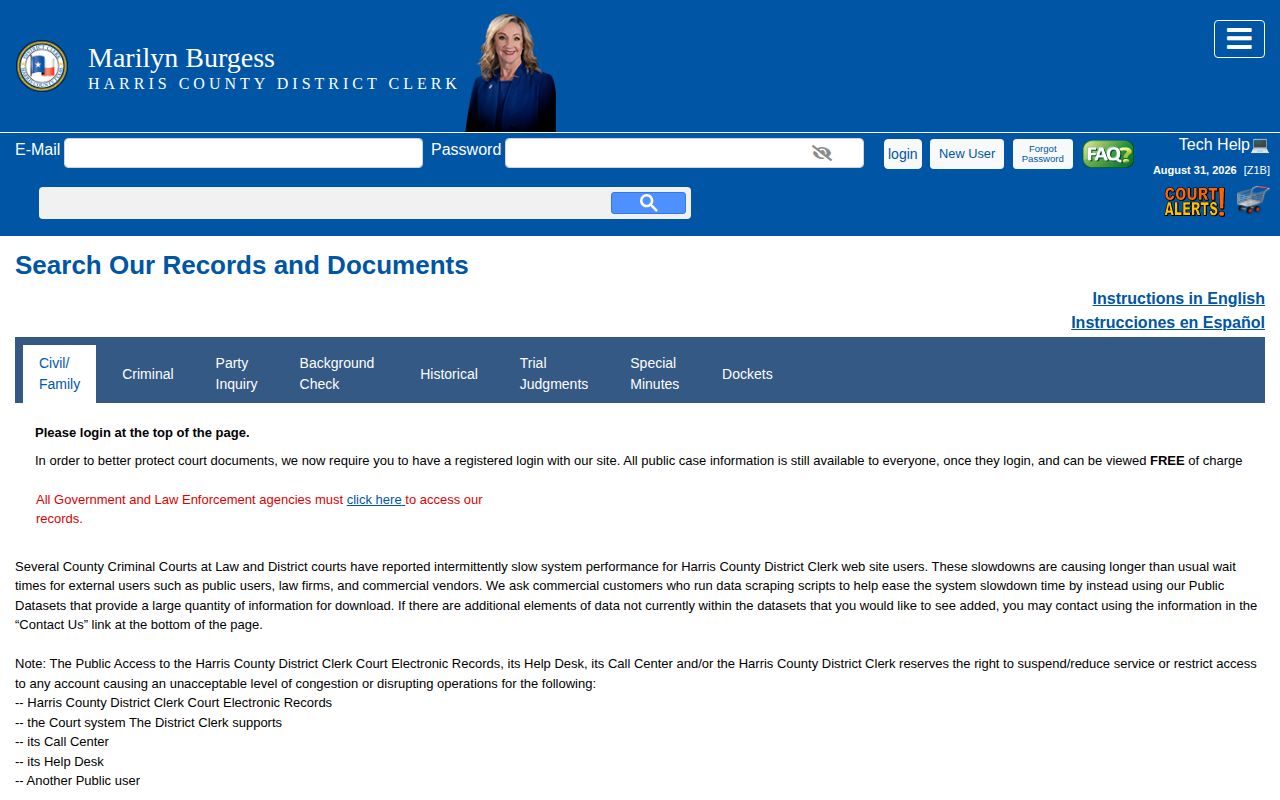
A court entry can show a case’s procedural path, but its absence from a search should not be treated as proof that no case or warrant exists.
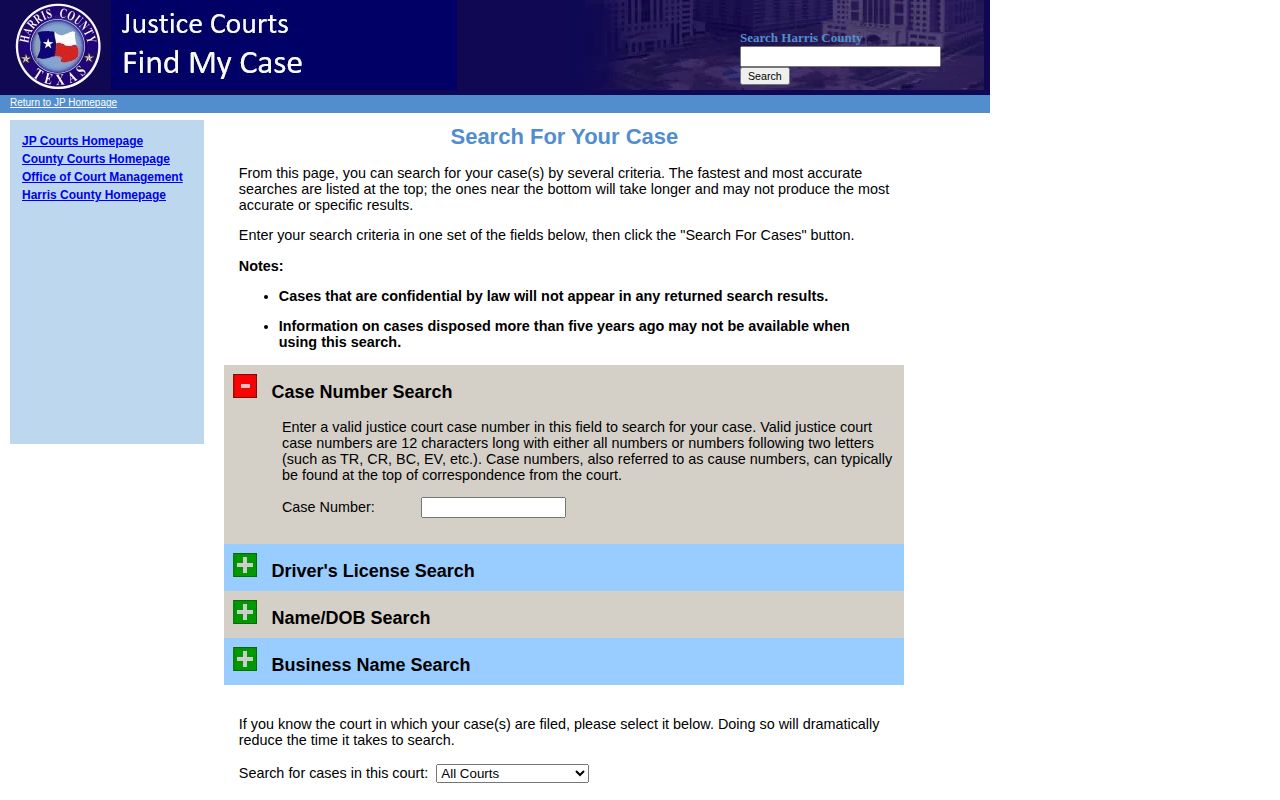
For justice-court matters, the Harris County JP case search is a separate route. It warns that confidential cases are not displayed and that older disposed cases may be missing. HCSO’s Offense Inquiry can help follow the court setting and disposition after an HCSO booking or when an SPN or offense number is known.
The Harris County JP case search shows the distinct justice-court route for checking a case after the warrant question is verified.
Booking, a wanted notice, and a court disposition are three separate stages. A person can drop off a current roster for many reasons. Bond, release, transfer, or a court appearance will do it. The case itself keeps moving either way. It cuts the other way too. A warrant may attach to a case that never shows up in a current jail result.
A disposition records what the court finally did with a charge. The outcome could be a conviction or an acquittal. It might be a dismissal, deferred adjudication, nolle prosequi, or a no-bill. A reduction, a transfer, or a matter still pending also count. The actual order and the court handling it determine the effect. If no disposition turns up in a public search, the only safe conclusion is that none was located there.
The court routes have edges worth knowing. The District Clerk covers Harris County criminal courts and nothing else. Federal courts are outside it. So is a universal Class C municipal search and other counties. The JP site carries its own confidentiality and older-case gaps. For a verified warrant question, go to the office that issued it. Stitching together partial results from unrelated systems is not a reliable path to an arrest record.
Harris County Alerts Are Not a Roster
Alerts and rosters serve different jobs. The official Harris County Sheriff TX Android app is an outreach channel for crime reports, tips, and public-safety news, and HCSO's Media + News page posts selected releases and safety announcements. Neither one works as a complete jail roster, a routine booking-photo feed, or a stand-in for court records. A notice can flag a wanted suspect or a safety concern without a booking behind it.
Use these channels for timely official word, then turn to the warrant, custody, and court routes for the specific question. HCSO frames both tools as communications aids, not as a prompt to find or confront anyone. Facing an immediate threat? Call emergency services rather than leaning on a webpage.